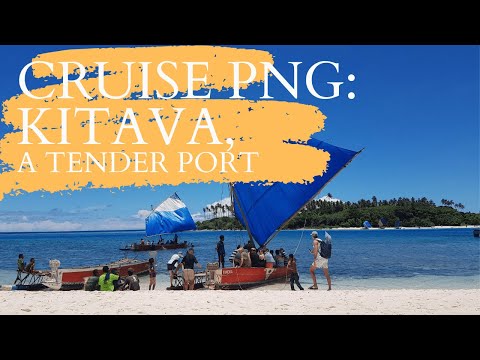
Tender port of KITAVA PNG
October 13, 2018
55 views
Good morning! Time for another walk — we’re currently off the coast near the Panama City area, and on our way to Papua New Guinea. Actually, we’ve arrived — we visited Alotau yesterday, and today, we’re going to a place called Kitava, one of the Trobriand Islands.
Now, look at this sunrise — the sun is just peeking through, casting this soft pink glow across the water. The camera honestly doesn't do it justice. There’s this rich red line hugging the horizon — just beautiful.
We’re moving quite slowly today. The distance between Alotau and Kitava isn’t huge, so there’s no rush. That gives us time to relax and enjoy the view.
Today is what we call a tender port. So what does that mean?
Well, when a cruise ship arrives at a port, there are generally two ways for passengers to get ashore:
The standard option — the ship docks at a pier, and passengers disembark directly.
The tender option — where the ship anchors offshore, and small boats ferry passengers between the ship and the land.
These boats are often the ship’s own lifeboats, lowered into the water and used as tenders. In some ports, the cruise line might hire local tender boats instead.
Now, every cruise company does this a little differently, and even ships within the same fleet can handle the process differently. So when people say, “This is exactly how it works,” take it with a grain of salt. Because the truth is: you only find out how it works when it happens.
Now let’s talk docks for a second — I used to think industrial shipping docks were just ugly. But over time, I’ve come to appreciate them. They’re these massive feats of engineering, handling people, containers, cargo — they really are poetry in motion. And they're essential to global travel.
Here’s a basic truth about cruising: nothing and no one leaves the ship until the local port authority or country’s immigration has officially cleared the vessel. Even if you can see land — you can’t just walk off the ship until the legal process is done.
I’ve seen people standing in lines for an hour just to be first off the boat. Honestly, there's no need. Sit down, enjoy your coffee, chat with someone. You’ll get off when you get off — no sooner.
So, what are the different ways cruise lines handle tendering?
Here’s what I’ve experienced over the years:
1. Ship’s Own Lifeboats as Tenders
The survival craft (yes, lifeboats!) are lowered into the water. These are crewed by trained staff and used as shuttle boats. Often, they rotate which boats they use so they can continually assess and maintain them — which I find very reassuring. It’s like a live safety drill that doubles as transport.
2. Local Tender Boats
Sometimes the cruise line contracts local providers to operate the tenders. Cruise staff are still onboard to assist, but it’s a community engagement as well — supporting local employment and tourism.
3. Different Boarding Systems for Passengers
Stand in Line: The most basic method — line up and wait for the next available tender.
Numbered Ticket System: Go to a desk, get a ticket with a number. Wait in a public space until your number is called. Then head to the designated lounge (like the Marquee Theatre), and get escorted to the tender
Open Waiting Areas: Sit in a lounge or other public area. Once a tender is ready, they announce the group number — and you head down.
Excursion Priority: If you’re booked on a cruise-sponsored shore excursion, you’ll usually get priority boarding. You meet in a specific area at a designated time and get called as a group when the tour provider is ready.
Cruise lines have been refining this process for decades. You’ll get to shore eventually — just follow instructions and be patient.
A quick tip: always bring your cruise card and a government-issued photo ID. When you disembark, your card gets scanned, and sometimes your ID is checked. Many cruise lines use facial recognition now, so it’s important that you hold your own card — don’t give it to your partner or friend. I’ve seen people get held up at the gangway because one person was carrying everyone’s cruise cards — and it doesn’t work.
Just now, the captain made a public announcement about how the tendering will work today for Kitava. They’ve decided to go with the numbered ticket system. You head down to the desk, get your ticket, then wait in the public areas until your number is called. When it’s your turn, you go to the Marquee Theatre, and from there, you’re escorted down to the tender.
So, that’s today’s plan! Every port is a little different, every ship does it a little differently — but the one constant is that it always works out in the end
My book HANDY CRUISE COMPANION, Cruise with Confidence is available on Amazon
http://bit.ly/HandyCruiseCompanioneBook
Check out my website
http://www.julescruisecompanion.com.au/
Follow me on Facebook
https://www.facebook.com/julie.burgess.5011
Follow me on Instagram
https://www.instagram.com/julescruisecompanion/?hl=en
Copyright JCC