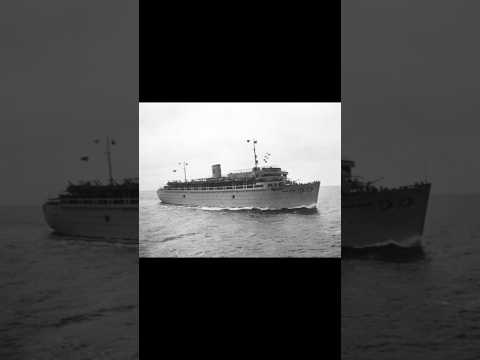
The Life of MV Wilhelm Gustloff #cruiseship #ship #shiplife #shipwreck #ww2 #history #disaster
January 11, 2026
1.1K views
Launched: 5 May 1937
Maiden voyage: 24 March 1938
Fate: Torpedoed & sunk on 30 January 1945 by Soviet submarine S-13.
Wilhelm Gustloff was the 1st purpose-built cruise ship for the German Labour Front & used by subsidiary organisation Strength Through Joy.
Constructed by the Blohm & Voss shipyards & was launched on 5 May 1937. Originally intended to be named Adolf Hitler, the ship was instead named after Wilhelm Gustloff, who had been assassinated by a Jewish medical student in 1936. The ship made her unofficial maiden voyage between 24 & 27 March 1938 carrying Austrians in an attempt to convince them to vote for the annexation of Austria by Germany. On 29 March she departed on her 2nd voyage carrying workers & their families from the Blohm & Voss shipyard on a three-day cruise. For her 3rd voyage, the Wilhelm Gustloff rescued the crew of the sinking British coal freighter Pegaway in the North Sea. The ship went on an Easter Voyage before her actual official maiden voyage, which was undertaken from 21 April to 6 May 1938. On the 2nd day of her voyage, the 58-year-old Captain Lübbe died on the bridge from a heart attack. He was replaced by 1st Officer Friedrich Petersen, who commanded Wilhelm Gustloff for the remainder of the cruise & later serve as captain on the ship's final voyage. Wilhelm Gustloff remained as flagship of the KdF cruise fleet, her last civilian role, until the spring of 1939, when all large ships were requisitioned for wartime use. From September 1939 to November 1940, Wilhelm Gustloff served as a hospital ship. On 20 November 1940, medical equipment was removed from the ship & she was repainted from the hospital ship colors to standard naval grey. Wilhelm Gustloff sat in dock there for over 4 years. Wilhelm Gustloff continued to serve as a barracks until 1945, when she was hastily repurposed for Operation Hannibal (the naval evacuation of German troops & civilians from East Prussia & the German-occupied Baltic states as the Red Army advanced from the east). The ship's complement & passenger lists cited 6,050 people on board, but these did not include the many individuals who boarded the ship without being listed in the official embarkation records. The ship was overcrowded & due to the high temperature & humidity inside, many passengers defied orders not to remove their life jackets. The ship left Gotenhafen at 12:30 pm on 30 January 1945, accompanied by 2 torpedo boats & another evacuation transport, Hansa. Hansa & 1 torpedo boat were soon disabled by mechanical problems, leaving Wilhelm Gustloff with just 1 torpedo boat escort, Löwe. The ship had 4 captains on board this resulted in heated arguments about how to guard the ship against Soviet submarines. Wilhelm Gustloff's captain, Friedrich Petersen, turned the ship into deep waters. Upon being informed by radio of an oncoming German minesweeper convoy, Petersen ordered that the ship's red & green navigation lights should be turned on so as to avoid a collision in the dark, making Wilhelm Gustloff easy to spot. Wilhelm Gustloff was soon sighted by the Soviet submarine S-13, under the command of Captain Alexander Marinesko. At around 9pm (CET), Marinesko ordered his crew to launch 4 torpedoes at Wilhelm Gustloff's port side, about 30 km (16 nmi; 19 mi) offshore, between Großendorf & Leba. The 3 torpedoes that were fired successfully all struck Wilhelm Gustloff on her port side. The 1st struck the ship's bow; this caused the ship's watertight doors to lock before the sleeping off-duty crew could escape. The 2nd hit the accommodations for the women's naval auxiliary, located in the ship's drained swimming pool. The 3rd torpedo scored a direct hit on the engine room located amidships, disabling all power & communications. Reportedly, only 9 lifeboats could be lowered; the rest had frozen in their davits & had to be freed with tools. About 20 minutes after the torpedoes' impact, Wilhelm Gustloff suddenly listed so dramatically to port that the lifeboats lowered on the high starboard side crashed into the ship's tilting side, sending their occupants into the sea. Many deaths were caused either directly by the torpedoes or by drowning in the inrushing water. Some fatalities were due to the initial stampede caused by panicked passengers on the stairs & decks, while others were caused by passengers jumping overboard into freezing waters. The water temperature in the Baltic Sea on this particularly cold night, with an air temperature of −10 to −18 °C & ice floes covering the surface. The majority of those who died were victims of hypothermia. Less than 40 minutes after being struck, Wilhelm Gustloff was lying on her side. She sank bow-first 10 minutes later, in 44 m of water. All 4 captains on Wilhelm Gustloff survived her sinking. By 1 estimate 9,343 people died, making its sinking the deadliest recorded maritime disaster in history. The wreck site is officially declared a war grave & diving is illegal within 500m.